Living with Cerebral Palsy: Mario Kart & Power Steering

Since its inception in 1992, I’ve been a fan and master of Mario Kart. I won championships on the Super Nintendo, shattered records on the N64, and continue to take checkered flags on the Wii. I’ve always been a Yoshi guy in case you wondered. Playing with my boys this morning I had to repeatedly correct young Andrew’s technique. Almost all young drivers make the same mistake – über steering. Full body, electrocution-like over corrections to the slightest indication of a turn leaves his poor driver spinning donuts while the other drivers lap him. See, the trick to becoming a Mario Kart Jedi (May the 4th be with you.) is mastering the art of subtle steering. It requires the deft touch of the Operation masters of old. Where I am a paring knife of precision, Andrew is a Dwarf’s battle ax of chaos. After I went Dale Sr. on Andrew and Jackson, I took Caedmon onto my lap to help him drive against his brothers.

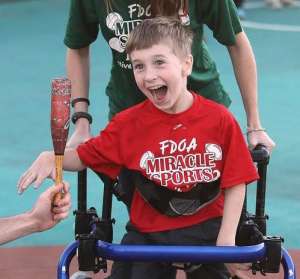
I’m not sure which muscle groups are firing or which tendons are tight, but when Caedmon sits in my lap his legs and lower back stiffen and push his shoulders against my chest. It’s not an intentional act, but it is difficult to keep him sitting upright. He tends to slide down my legs, his toes pointed and legs rigid like an Olympic diver entering the water, and his shoulders inching toward my belly button (sorry for that mental picture). Eventually he must be pulled back against my torso, where the gradual slide begins anew. He has better control of his right hand than his left, so he will grasp the controller and I’ll place his thumb on the gas and my thumb on top of his.

Jackson has the race picked and the red light has already burned. Caedmon’s left arm is parallel to the floor, straight as marine’s sideburns. I take his left hand in mine and with delicate force bring it to the other side of the controller. The red extinguishes and the yellow illuminates the screen. Caedmon gets excited, his body stiffens, and he slides further down my leg. Just before the light turns green, I hitch him back in place, reset his hands, and the race is on.

Andrew’s whirling around like the Star Wars Kid, Jack, following in dad’s glorious Kart race marks, carefully navigates Toad around the course (he prefers Yoshi too, but I pulled rank), while Caedmon and I drive Wario. It reminded me of when a car’s power steering goes out. There is tension in seemingly every muscle threaded through Caedmon’s frail arms. A quarter-inch tweak on the four-ounce Wii remote requires the force (not THE Force) associated with opening the trunk of a 1985 Cadillac. His body simply doesn’t move the way we want it to. He lacks the dexterity to manipulate the buttons for more complex games, but he’ll shoot hoops on Wii Sports Resort, spin the Wheel with Pat and Vanna, and hit the links on Wii golf. Other times he gets help from me, Jeni, or any number of other people who love him and like video games. The competitor inside me wishes his little Kart had power steering, but I know he simply loves the time shared with the Sprague boys and I’m good with that.

Oh Boy!

Maybe a house full of girls is just like mine, but I doubt it. Their combined age is 20, but the combined testosterone of my four boys has already reached Macho Man Randy Savage levels (Oooooooh Yeeeaaaaahh!). Poor Jeni.

Caedmon, Jeni, and I were finishing a nice lunch of grilled cheese and pretzels, chocolate chip cookies were baking and providing a soothing aromatherapy, and Jack was lost in a creative wonderland of paper and markers. It was serene, almost Mediterranean; but the Sirocco was moving down the hallway - Andrew and Toby, armed with cardboard box helmets, pin-balling toward the living room.

A new game was born in the man-sion this afternoon: Boxosaurus. When all twelve cookies were consumed (about twelve seconds after they left the oven), Jack donned Toby’s box helmet and the game was truly on. Like two cymbals in the hands of an uber-enthusiastic middle schooler, they crashed into one another over and over again.

Jeni had taken Caedmon down the hallway and I walked down to discuss a trip to Highlands. As we spoke I was rear ended by Boxosaurus Andrew and the sleeping matador stirred.

I stepped away from the door as Drewsie backpedaled for another charge. He ran at me full speed, ready to conquer Mt. Dad. As a firm believer in establishing a clear understanding of cause and effect relationships, I stepped to the side. My darling child crumbled into the wall and fell to the floor; he was laughing harder than I was.

The bull fighter routine continued with Jack and Andrew for roughly half a down more approaches. Like a drunken brawler, they threw themselves toward their mark only to find their mark had moved. Banging into walls, colliding into walls, and smashing into Caedmon’s wheelchair before Jeni insisted I was cruel and should grow up. She was right, so I threw a copy paper box over my own noggin and moved the ruckus into the master bedroom.

A few well-timed assaults from Boxosaurus Andrew and Jack found me laying against my bed being pummeled by cardboard. Caedmon had moved in to referee the bout, but before he could rule the K.O. – POP!

My eyes were closed, Jack was right in front of me. The last thing I felt was Andrew bouncing himself off my left shoulder.

I’m rubber, he’s heavy and free of inhibition,
what bounces off me, shatters body length mirrors.
(That’s how it goes, right?)

I opened my eyes to find Andrew lying against a once vertical mirror, now  shaped like a taut bow and shattered like a car windshield after a crash. He was wide-eyed, not sure if he was hurt. I picked him up, placed him to my right, and assessed the situation. All the glass was still in the frame, save a few tiny pieces I quickly picked up. Knowing everyone was safe, the laughter began anew, my laughter. The boys were shell-shocked and headed back out into the living room. Jeni came in with that “I told you someone would get hurt, ya big clown” look on her face.

She was wrong though; nobody got hurt, and it wasn’t even close. Who hasn’t fallen through a five-feet tall mirror unscathed? It’s part of growing up, part of becoming a MAN!

Toby and I took the shattered mirror to the trash. Jeni made plans for a Wal*Mart trip for a replacement mirror. Caedmon, Andrew, and Jackson played Mario Kart on the Wii. And the boxes lay in wait for the next round of Boxosaurus.

Collateral damage. Man-tastic!

The fun continued with Closet Money Bars.

Extraordinary Books: Schuyler’s Monster

I hesitate to review authors on their literary technique; it would be akin to me critiquing igloo architecture. However, I will address content within the books I post on Nobody’s Normal. I recently finished “Schuyler’s Monster: A Father’s Journey with his Wordless daughter” and it absolutely fits on the Nobody’s Normal bookshelf. Robert Rummel-Hudson writes from the familiar, at least to me, perspective of a dad coming to grips with his child having a disability. The shock of the diagnosis, the instant sense of ignorance, the struggle between the professional’s expertise and the parent’s intuition, etc. While living in this extraordinary culture has moments of beautiful sunsets, it also has hurricane moments and Rummel-Hudson’s family weathered a few storms.

Reading of their intense battle with the Special Education teacher, the school board, and the system were reminiscent of the frustrating moments my friends have shared. Schuyler (pronounced, Sky-ler) was bullied by the teachers who were trusted to look out for her, using her inability to speak as their cloak. It was an appalling account. I enjoyed his retelling of their discovery of communication devices; he calls it her “big box of words.” Jeni and I have been there, along with many of you – the rose of technology and the thorn of expense.

Schuyler has something called Bilateral Perisylvian Polymicrogyria (BPP); I’ll let the author explain.

The monster has a family name, an imposing handful of syllables the doesn’t feel natural on the tongue no matter how many times you say it. Polymicrogyria. Despite its heft, however, the word breaks down into very easy pieces. Poly, or “many.” Micro, or “small,” and gyria, which are the folds in the surface of the brain, the things that make a brain look like a brain. A typical brain is composed of many different folds, but in a brain afflicted with polymicrogyria, there are too many of these folds and they are smaller than they should be.

As you might guess, mom and dad were ignorant of BPP prior to Schuyler’s diagnosis. Just like Jeni and I were ignorant of Cerebral Palsy, and most other extraordinary parents were before their child was diagnosed. It’s indicative of our Normal culture. Struggling to allow their wordless daughter to communicate, striving to get an accurate diagnosis, and investing their entire selves into their daughter’s world were catalytic for their own drifting apart. Rummell-Hudson frankly shares the destructive patterns that led to infidelity in their marriage. Their’s is a warning for all extraordinary parents to heed.

The author also shares some deep struggles he has with God, or the idea of God. Who among us hasn’t asked difficult questions? Who is immune from doubt in light of personal struggle? He is unflinching in his retelling, honest and real. Ultimately, for Rummel-Hudson. the most profound question he ponders is how Schuyler is so radiant and hopeful in spite of her diagnosis. “She is the source of my joy and my sorrow, and for all my resentment at him for giving her this burden, it is nevertheless when I am with Schuyler that I feel closes to God.”

(Please be aware this book has some rough language, deals with some unfortunate decision-making, and has at least one incident where a description that, while truthful, was unnecessary to the story and depicts immoral behavior. Schuyler’s Monster is compelling and it will resonate with many, but its a PG-17 read. Just FYI.)

Robert Rummel-Hudson, Speaking of Normal

“I don’t care what’s wrong with her,” she said. “If she can’t behave like a normal kid then she shouldn’t be out in public with the rest of us. Maybe you should have her institutionalized if she can’t do any better than that.”

Taken from Schuyler’s Monster, by Robert Rummel-Hudson. The quote came from an unsympathetic stranger in the grocery store.

Autism Awareness Month

Nobody’s Normal is wearing different clothes for the month of April – blue for Autism Awareness. Joining advocates all over the country, this is just a simple way to raise awareness and increase conversation. I’ve got a few friends on the spectrum, and I’m glad to do my part.

Tomorrow is a world-wide campaign to “Light it Up Blue” by picking up a blue light bulb and installing it on your front porch. You’ll see the Sydney Opera House, Christ the Redeemer in Brazil, The Empire State Building, The Cairo Tower in Egypt, The Paris Stock Exchange all shaded blue, but you won’t see the White House joining the cause. A friend has been personally involved in the campaign to get President Obama to participate, and you can read about it on his site (Baffling, The Missing Color, Letter to the President, and Obama’s Automated Response).

You don’t have to know all the answers to Light it up Blue. Just grab a blue shirt, install a blue light, change the background on your blog, or play Elvis’ most well-known Christmas tune all day, it’s up to you.

Autism Speaks.

Complicated

“There are times when our hope despairs; these are the times our despair must learn to hope.” – Martin Luther

The following is an attempt to work out my thoughts and feelings through poetry. I’m not exactly sure what qualifies something as poetry, but I had poetry in mind so I say it counts. My boys are reading a book called “Dream Something Big: the Story of the Watts Towers.” These nearly 100-foot-tall towers were crafted by a man out of seashells, discarded tiles, mirrors, and rocks – trash made triumphant.

Nothing I’m about to share qualifies as trash, but they’re the elements that went into writing my poem. Because Caedmon’s getting bigger and Jeni’s getting more pregnant, loading him in and out of the car, getting him bathed, and lifting the new, heavier wheelchair are about to become impossibilities for her. I’m in a longstanding conversation with a friend asking, “where is God in all this?” Did He cause it? Did He allow it? Was He taken by surprise? Was it an act of war from Satan’s camp? Some days I know, others I don’t. I’m considering accepting a new job that will have me out of the house three days a week. I need to provide, but what about Jeni and growing Caedmon?

Questions.
Ideas.
Real circumstances.
Resolve.
Doubt.
Truth.
More questions.

After a canceled meeting, I sat alone with my wine & cheese sandwich, Schuyler’s Monster, root beer, and notebook and I began building my own little, emotionally cluttered Watts Towers. I call it, “Complicated.”

I’ve grown convinced of how little I know.
I don’t know how: physics, mathematics, chemistry, genetics…

Worse still, I don’t know why: brilliant minds and damaged brains, refreshing breezes and destructive hurricanes…

None of them are Normal, but one of my sons has Cerebral Palsy. The wheels light up and it glows in the dark, but it’s still a wheelchair. The iPad is cool and a dog will be fun, but they’re poor replacements for voice and strength.

Cerebral Palsy is a Jane Austen novel, and I struggle with my alphabet.
How did his brain get damaged? Lack of Oxygen, simple as A-B-C.
Why did his brain get damaged? Um… Because he, uh… Well…, Austen.

Some say there is no why. They believe everything’s causeless, purposeless, wonderless. It is what it is; deal with it.

I hate that idea.
Because that idea leads to hate.
Hate them. Hate me. Who cares?

Others say there is a why. Things do have a cause, a purpose, a reason for wonder. It is what it is; look for it.

I like this idea.
Because this idea leads to hope.
Hope for a reason. Hope for tomorrow. Someone cares.

The Bible says, “faith is being sure of that we hope for.” I believe God is there, but I don’t know what to hope for. I want Caedmon to run, play, feed himself, chase his friends, dance, speak his stories, dress himself, and bake brownies if he wants. Can I hope for these things? I’m sure I’m not sure they’ll ever happen.

Faith as small as a mustard seed can move a mountain,
but a mustard seed is a mountain next to my faith.

Yet every trip to the physical therapist is motivated by hope.
Each time we practice making a P sound we’re prompted by hope.
Hope for improvement. Hope for one more step, one more sound,
one more reason to… hope.

Caedmon is the springtime.
Cerebral Palsy is the pollen.
Every time my hope is smothered in a yellow cloud of despair, Caedmon’s relentless, transcendent joy washes it away and teaches my despair to hope.

I don’t know exactly how, but I pray.
I’m not sure if it’s foolish, but I hope.
Perhaps, on days when they meet, my faith will be strong.

Maybe a mountain will move.
But where did that mountain come from?
It’s complicated.

Trying to be Normal

Have you ever tried to fit in? I have, and it didn’t go well. The setting was Blue Ridge Elementary School in Augusta, GA. It was about 1988 and I was a fifth grader desperate to be cool. The cool kids wore Coca-Cola clothes, Umbro shorts, and Reebok Pumps (not necessarily at the same time, but how cool would that have been?). My parents didn’t fall for the hype machine, so I went without the totally awesome threads, but I still found a way to fit in.

I guess everyone wanted to be like Uncle Jesse (this one, not this one) because hair gel was all the rage. But I didn’t know hair gel existed; I just thought everyone had wet hair. The first thing I did when I got to school each morning was lean into a bathroom sink and drench my head – sopping, soaking wet. As my hair dried, my bladder grew sensitive and a trip to the bathroom / hair salon occurred. Why didn’t anyone stop me? Where were the loving, caring adults in my life? How could they just stand aside and let me wash any chance of becoming cool down the drain? The fact that I was trying so hard to be cool just proved I was far from it. This is exactly what Jacob was talking about in yesterday’s “Speaking of Normal.”

Normal is as arbitrary, unfair, and cruel as Cool. Who decides? What qualifies? ’80s cool is ’90s lame, and ’90s cool is today’s “really?” Not being Cool is temporarily miserable, but not being Normal can be incurably catastrophic.

I know having Cerebral Palsy requires extra attention, mobility accommodations, and communication assistance. I know living with Autism demands unorthodox parenting, extra precautions, and creative relationships. Blindness, deafness, Multiple Sclerosis, NBA height, NFL size, uncommon brilliance, or fiery red hair all bring with them uniqueness, specific reactions, and sometimes specific clothing. They’re all different, none are Normal, yet collectively they’re all the same.

No one has to try to be Normal, because nobody’s Normal. Like shards of a stained glass window, we’re all unique, purposeful, precisely where we should be, and part of a bigger, more beautiful picture. Red need not strive to be green, and small need not envy the large. It’s only when red begins to believe his hue is Normal that problems arise.

Robert Rummel-Hudson wrote in his book, “Before we ever moved there, I bought Schuyler the obligatory T-shirt (Keep Austin Weird). A college town and hippie haven, Austin was the perfect place to bring Schuyler. It was a place where everyone was weird, which meant no one was.” It’s just a way of saying nobody’s Normal in Austin, TX. Wouldn’t it be great if that were true everywhere?

Gotta love Austin.


Extraordinary Art

One of the books I’m currently reading is called “Why, O God? Suffering and Disability in the Bible and Church,” edited by Larry Waters and Roy Zuck. As you might guess, I’ve got plenty of questions on these issues, but I’m not writing about the prose; I’m writing about the pictures.

I can’t think of a time I’ve ever been moved (whatever that means) by a work of art, but one of the book’s pictures grabbed my heart. It’s called “Two Brothers.”

I saw my boys in this picture. What would they do if they lost their mom and dad? Would they lean on each other and care for each other like these brothers? How can I cultivate this kind of deep, fearless, brotherly love in the hearts and minds of my sons? I don’t think the answer is simple, but I’m sure working on it.

Every time I hear them fight for a toy, compete for a place at the table, or scream to be heard over their yelling sibling my heart hurts, because they are clinging to things while they discard their brothers.

However, when I see them hug for no reason, share without prompting, or help Caedmon with genuine compassion my heart sings, because they are clinging to one another.

Maybe, if everything were stripped from them, like the brothers in this picture, they would cling tighter still. I hope they will do it anyway.

I’ll write more about “Why, O God?” in time, but you might want to pick up a copy in the meantime. You can read about the two brothers from the Philippines who inspired the drawing on Dawn Waters Baker’s blog.


Thoughtful Inclusion

What’s the proper way to include someone? As difficult as the answer might be to find, we must continue to ask the question. Yesterday’s Speaking of Normal reminded me of a wrenching scene from the movie My Left Foot.

It’s a biographical movie about Christy Brown, set in Ireland around 1940. Severe Cerebral Palsy left Christy only able to operate his left foot with any sort of dexterity. He’s in a makeshift bed and he’s apparently hot, because he goes through an incredible ordeal to kick off a wool blanket. A few minutes go by before he finally succeeds, and his face lights up with a sense of accomplishment. His guardian enters the scene, makes a quick assumption about the situation, and throws the blanket back across Christy. It’s infuriating. Jeni can’t watch.

Our first, and perhaps most common, mistake in including our extraordinary friends is to assume we know what they want. This is especially important with someone who is non-verbal. It takes time to enter their world and understand what they need or want, but oftentimes we get in a hurry and just throw on a blanket. Jesus’ convicting words come to mind, What father among you, if his son asks for a fish, will instead of a fish give him a serpent; or if he asks for an egg, will give him a scorpion?” (Luke 11:11-12) Before we offer a scorpion in good intention, let’s take the time to see what our friends really need.

Another Normal assumption, is to think an extraordinary person wants or needs a place of their own. We visited a church recently, and a well-meaning, genuine individual talked with our family and told us all about their Special Needs Room. This person didn’t introduce himself to Caedmon, didn’t ask his name, and didn’t mean to exclude, but he did. He saw the wheelchair, and he assumed he knew what Caedmon would want. The last thing Caedmon would want is to be relegated to a separate room, void of friends, and left feeling like Jacob did from the Speaking of Normal quote. I think it’s great they’ve had the thoughtfulness to create the room, but we must not assume a person will want to occupy it. Separate isn’t equal, especially for a child.

What I propose requires time, effort, creativity, resourcefulness, willingness, and patience. (Not to mention money.) But I can’t help but think back on the Golden Rule; you remember, “So whatever you wish that others would do to you, do also to them…” (Matthew 7:12). We forget this sometimes. When we’re asking our inclusion questions, we should let this be our guide. If I were in that situation, how might I feel? What would I want? What would I need? We should allow ourselves the time to imagine what our extraordinary friends are experiencing, maybe even asking them directly.

We just need to be thoughtful. If we’re thoughtless, are we really being loving? If we’re projecting ourselves and our assumptions onto the situation, are we really understanding? Inclusion doesn’t always require an expensive, time intensive process; more often than not it’s simply looking someone in the eyes and saying hello. Inclusion demands that we recognize a disability but don’t define by the disability.

Later in My Left Foot, Christy’s brothers and friends demonstrate thoughtful inclusion. All the guys are off to play soccer in the street, and leaving Christy at home isn’t an option. They race to their cobblestone pitch, place Christy in the goal, and share the Beautiful Game together. Christy made an excellent goal keeper, and even had a wicked shot on their free kicks. The boys found a thoughtful way to include their brother. Beautiful.